
Monthly Caps That Survive Real Subscriber Habits
OnlyFans spending stays under control when the number you set matches your actual habits rather than your intentions. A monthly cap that survives real subscriber behaviour is built from renewal dates, pay-per-view triggers and tip patterns, so this guide focuses on the design rather than the figure alone. BestOnlyFans refreshes its rankings every month.
Most people set a limit in a quiet week, then meet a busy month and override it twice before the cap quietly disappears. The fix is to map what you already pay, size the variable portion honestly, and build in headroom so a normal month does not break the plan. BestOnlyFans treats a cap as a structure, not a promise. The BestOnlyFans method stays consistent across updates.
Why Most Caps Fail in Month Two
A cap fails for a boring reason: it was designed against a total rather than against a calendar. Renewals cluster on the days you originally subscribed, and those dates do not move just because a new month started. When three renewals land in the same week as a pay-per-view unlock, a flat ceiling feels broken even though nothing unusual happened.
The second failure is trigger blindness. PPV messages arrive when a creator sends them, not when your budget is ready. If your cap has no rule for those moments, every unlock becomes a small emergency and each override weakens the limit a little more.
The third failure is the razor-thin ceiling. A cap set exactly at your average spend is breached roughly half the time by definition. Any month with one extra unlock or one promotional renewal pushes it over, and a limit you exceed constantly stops working as a limit.
Before setting any number, open your statement and count how many separate charges hit the platform last month. If the count surprises you, your cap needs a calendar, not a smaller figure.
Mapping Fixed Costs First
Start with what is already committed. Fixed costs are the charges that will occur whether or not you log in: active subscriptions with auto-renew on, renewals you know are coming, and any wallet top-up you schedule in advance.
Paid subscriptions run from $4.99 to $49.99, with most sitting in the $4.99 to $15 range and averages clustering around $5 to $10. Free pages sit at $0 and earn through PPV and tips instead. Promotional first months can sit below $4.99, for example a $3 first month, while base prices cannot.
- Active subscriptions with auto-renew enabled, listed at their current base price.
- Known renewals, written with the exact day they charge rather than the month.
- Wallet top-ups you schedule in advance, treated as fixed because the decision is already made.
- Any promotional rate due to expire, flagged so the higher price does not arrive unnoticed.
| Cost type | Monthly amount | Predictability |
|---|---|---|
| Active base subscriptions | $4.99 to $49.99 each | High, same day each month |
| Promotional first month | Can sit below $4.99 | High, but rate changes after month one |
| Wallet top-up | Whatever you schedule | High if automated |
| PPV unlocks | Up to $50 per message | Low, arrives when sent |
| Paid chat | Commonly $3 to $5 per message | Low, depends on the conversation |
| Tips | Can reach $100 | Low, fully discretionary |
One detail matters more than the rest: when a creator raises a base price, auto-renew stops and existing access continues until the paid period ends. Mark that date in the calendar so you decide deliberately rather than by default.
Estimating PPV and Tip Exposure
Variable spending is where caps usually break, and it is also where past behaviour is most useful. Three months is long enough to include an unusual month and short enough to still reflect current habits.
- Pull the last three months of PPV unlock totals and write each month separately.
- Average the three figures, then note the highest month as your realistic ceiling.
- Do the same with tips over the same period and average them.
- Add the two averages together, then round up to the nearest whole currency unit.
- Compare that total against your income month to confirm the number is affordable, not just accurate.
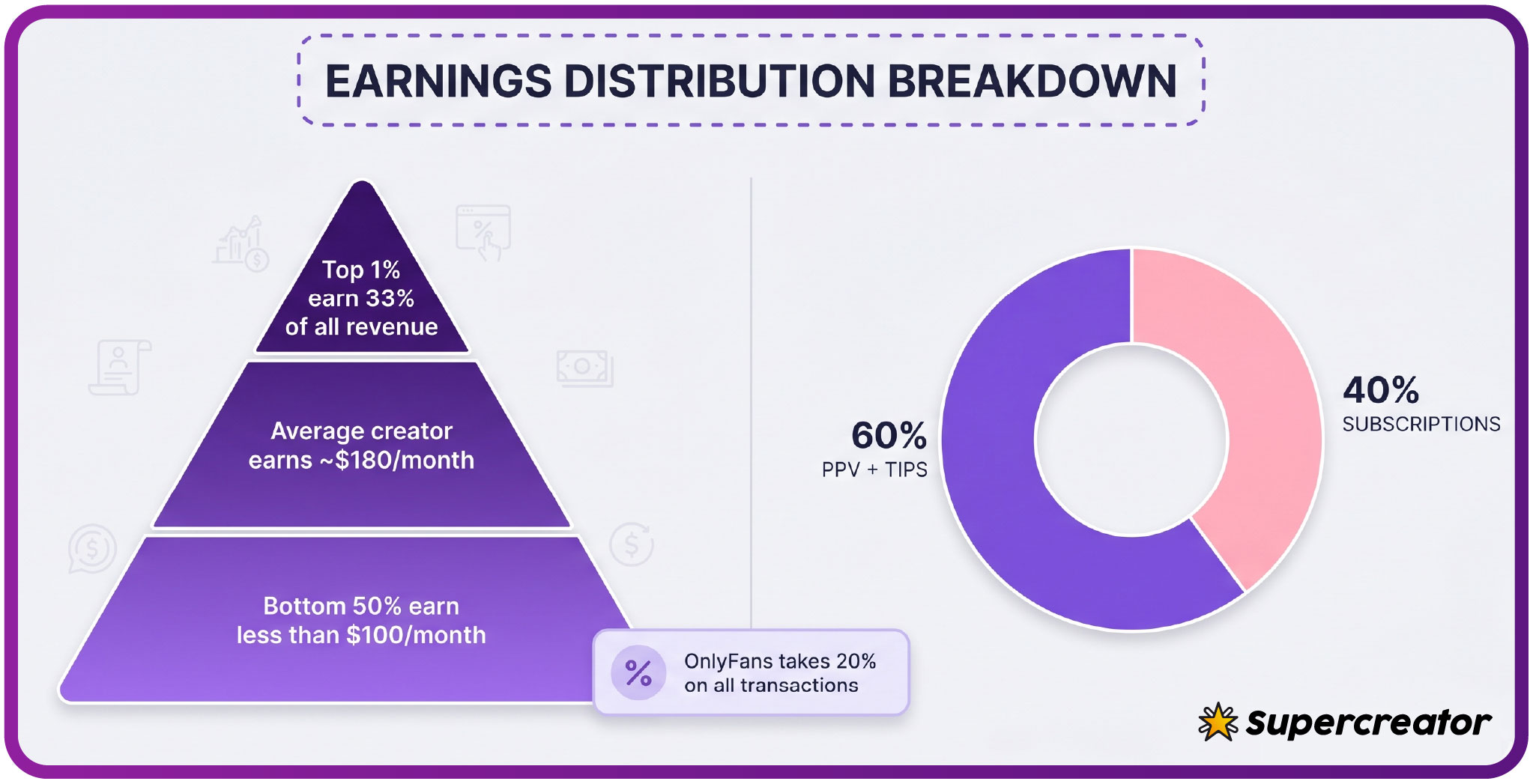
The platform fee is 20 percent on everything, so creators keep 80 percent, but that split does not change what you are charged. Your side of the ledger is the gross amount, and the cap should be written in gross terms.
Paid chat commonly runs $3 to $5 per message and PPV messages unlock up to $50, which is why a single conversation can consume a week of a thin cap. If your chat usage is regular, treat it as its own line rather than folding it into a general PPV estimate.
Setting the Cap With Headroom
A cap set at the average is breached constantly; a cap set ten to twenty percent above the average absorbs a normal busy week without being overridden. The goal is a ceiling you rarely touch, not one you fight every month.
A second layer helps: separate the fixed portion from the variable portion inside one total. Fixed renewals get their own sub-limit because they are unavoidable, and the variable sub-limit covers PPV, chat and tips.
| Cap level | Headroom | Risk of breach |
|---|---|---|
| Set exactly at the three-month average | None | High, roughly half of all months exceed it |
| Average plus ten percent | Small | Moderate, holds in ordinary months |
| Average plus twenty percent with a variable sub-limit | Realistic | Low, survives a heavy week and a price change |
Write the cap down in one place and give the fixed and variable parts separate lines. A split cap is easier to audit because you can see immediately whether a breach came from renewals, from unlocks, or from tips.
The Rule for Overrides
The problem is a cap with unlimited overrides, because that is not a cap at all. Define exactly one condition under which you may exceed the limit, and make the condition specific enough to check in ten seconds.
- Only one override per month, and it must be a real exception rather than a habit.
- Only during the final week, which prevents early-month drift that undermines the rest of the plan.
- Only with a matching cut elsewhere, such as pausing one subscription or skipping unlocks for two weeks.
- Only after writing the reason down, so the same trigger is visible if it repeats next month.
If the same override reason appears twice in three months, it is not an exception. Move that amount into the regular cap and stop pretending it is occasional.
Reading reviews about platforms is a good reminder that budget rules should come from your own records rather than from someone else’s spending. When a ranking site publishes guidance, check whether its method is described openly, the way best onlyfans genuine explains how it compares pages before recommending them.
Monthly Review Cadence
Fifteen minutes on the same day each month is enough, and consistency matters more than depth. Put the reminder next to whatever else you handle monthly, like a phone bill or a subscription audit.
- Add up last month’s total charges, split into fixed and variable.
- Compare each part against its sub-limit and note which one moved.
- Update the renewal list, removing cancelled pages and flagging any price change.
- Reset the cap for next month, raising or lowering it only if the previous two months justify the change.
Adjust in small steps. Raising a cap by a large amount after one heavy month turns a temporary spike into a permanent ceiling. Lowering it sharply after one quiet month produces a cap that fails in the next ordinary week.
Security belongs in the same review. Two-step authentication, which is documented in general terms under two-factor authentication, and a quick check of active sessions take a minute and prevent the kind of account compromise that turns into unexpected charges.
What to Do After a Breach
The useful question is which part failed: renewals you forgot, a PPV message you did not plan for, or tips that crept upward. Answer that before changing the number, because the cause usually points to the fix.

- Pause one subscription for the next cycle rather than cancelling everything at once.
- Skip PPV unlocks for two weeks, letting the message queue reveal which ones you wanted.
- Log the cause of the breach in one line so patterns are visible across months.
- Resume the normal cap once the recovery period ends, keeping the plan intact.
If a charge looks wrong, check the verification hold first: card verification places a $0.10 hold that is refunded within days and is not a subscription charge. For genuine billing errors, contact support through the help centre rather than disputing before asking, because a dispute can close access while it is investigated.
FAQ
How large should the buffer be above my average spend?
Ten to twenty percent of your three-month average is a practical starting point. Ten percent covers ordinary variation, while twenty percent also absorbs one heavy week or a promotional rate expiring. If you have breached twenty percent two months in a row, the average is wrong, not the buffer.
Should PPV be counted inside or outside the cap?
PPV messages unlock up to $50 each, so treating them as an outside extra removes the only real constraint. A separate line lets you see PPV spending clearly while keeping the total honest.
What if I share my card with someone else?
Then the cap must include both users’ charges, and each person needs their own sub-limit. If two people use one card, one person should own the monthly review.
Is a weekly cap better than a monthly one?
Weekly caps control pace but miss renewals that fall in the same week, which is where most breaches start. A monthly cap with a weekly check captures both the calendar and the pace.